Across much of Africa, women make up a large part of the farm workforce and head a large share of the rural households. Yet when researchers measure output, farms managed by women produce less than farms managed by men. The finding that should stop a reader is what happens when you hold the land constant. In the countries the FAO studied, take a woman's plot and a man's plot of the same size and the woman's plot still yields about a quarter less.
The Food and Agriculture Organization put a number on it in 2023. Gender inequalities account for a 24 percent gap in productivity between women and men farmers on farms of equal size.1 The important part is not the size of the gap. It is the cause. The FAO attributes it to unequal access, to inputs, to credit, to training and information, to secure land, and to a heavier unpaid care burden, not to any difference in how well women farm.1
The gap is not a measure of ability. It is a measure of what a woman is given to work with.
less output from a woman's plot than a man's of the same size, in the countries the FAO measured. The FAO attributes the gap to unequal access to inputs, credit, training and secure land, not to ability.
Source: FAO, The Status of Women in Agrifood Systems, 2023.
That distinction changes what the gap means. A gap in ability would be close to a fact of nature and largely fixed. A gap in access is something a system produces, which means a system can also close it. The 24 percent is a cross-country average, not a Zambian figure, and the exact number moves with method and place. But the direction is consistent across studies, and Zambia offers a direct test of the mechanism. Panel data on Zambian farm households found that improving access to productive inputs narrows the gendered productivity gap: as women get closer to the same inputs as men, they close much of the distance.3 The constraint behaves like access because it is access.
In Zambia the disadvantage is layered rather than single. Women head an estimated 30 to 40 percent of rural households, and female-headed households are typically among the poorest and least food-secure.4 Women more often hold land through a male relative rather than in their own right, which weakens the security that lenders and input suppliers look for. They have less contact with extension services and less access to credit. Each of these is a valve on the same pipe, and the productivity gap is what comes out of the end of it.
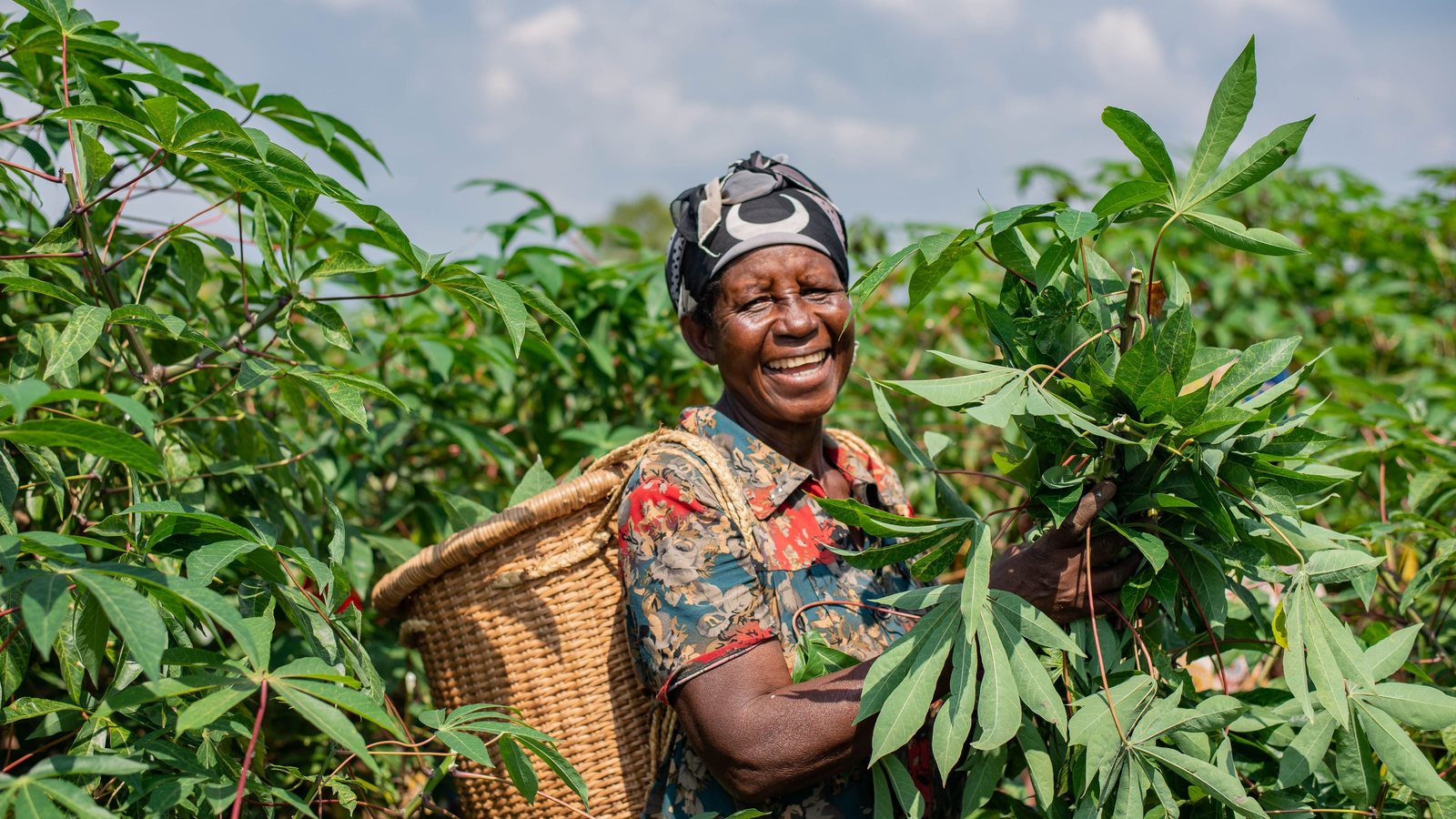
A smallholder at work. Across much of Africa, women do a large share of the farming, on land that yields less for reasons that have nothing to do with how well they farm.
This is why the gap is not only a welfare question. Read as an efficiency problem, it is expensive. The FAO estimates that closing the gaps in farm productivity and in agricultural wages could raise global economic output by about 1 percent, close to a trillion US dollars, and move 45 million more people out of food insecurity.2 That is a global estimate, not a Zambian one, but it reframes the woman farmer for a government or a funder. She is not a vulnerable group to be protected. She is a producer being asked to farm with less, and the output lost is the country's, not only hers.
There is one more constraint, and it is the one least often named. Finance reaches women last for several reasons at once: they hold land through someone else, they have little collateral, and the products on offer rarely fit them. But underneath those sits a plainer problem. A woman who farms well is often invisible to the institutions that could reach her. She sells informally and keeps no record of what she produced or repaid, so even a willing lender has nothing to assess. Zambian survey work has long shown women more likely than men to be financially excluded, with village savings groups filling part of the gap that formal finance leaves open.56 Invisibility is not the only barrier, but it sits upstream of the others: a lender cannot weigh a borrower it cannot see. So the two gaps feed each other. Less access lowers output, and invisibility keeps out the finance that would raise access.
None of this is closed by a single intervention, and the honest reading is that the deepest constraints for women, land rights, labour, the care burden, sit beyond the reach of any one company. Those need law, public investment and extension, not a data layer. But there is one layer that is routinely left unbuilt, and it can be built now: the record. When a purchase from a woman farmer is fair and written down, it leaves a verified account of what she grew and delivered, in her own name. That is one of the first assets that can make her legible to a lender on her own terms rather than her husband's. It does not replace inputs, secure tenure or extension, and it settles none of the larger constraints. It addresses one of them.
At Daka Ntembe Corporation most of the farmers we buy from are women, not by design but because that is who farms in the districts where we work. A record of a real transaction says more than a farmer's own account of her season, though a record is only worth trusting if it is accurate, consented to and carefully kept, which is work in its own right. We do not claim it is the missing piece. It is one of several things that would help a woman farmer, and the one we are able to build. The evidence keeps making one point, and it is the one worth ending on: the gap was never about ability. It is about what a capable farmer is given, and whether she is ever allowed to show what she can do.
References
- FAO (2023), The Status of Women in Agrifood Systems: a 24 percent gap in land productivity between women and men farmers on farms of equal size, attributed to unequal access, not ability. Link
- FAO / UN News (April 2023), on the 2023 report: closing the productivity and wage gaps could raise global output by about 1 percent (near US$1 trillion) and move 45 million more people out of food insecurity. Link
- Ngoma, H. and colleagues (2021), Can agricultural subsidies reduce gendered productivity gaps? Panel data evidence from Zambia, Development Policy Review 39(6). Link
- FAO, Zambia Country Gender Assessment of the Agriculture and Rural Sector: women head an estimated 30 to 40 percent of rural households; female-headed households among the poorest and least food-secure. Link
- FSD Zambia (2022), Women and Financial Inclusion in Zambia, FinScope 2020 focus note: women more likely to be financially excluded; savings groups fill part of the gap. Link
- CGAP, Policy into Practice: Zambia Advances Women's Financial Inclusion. Link